

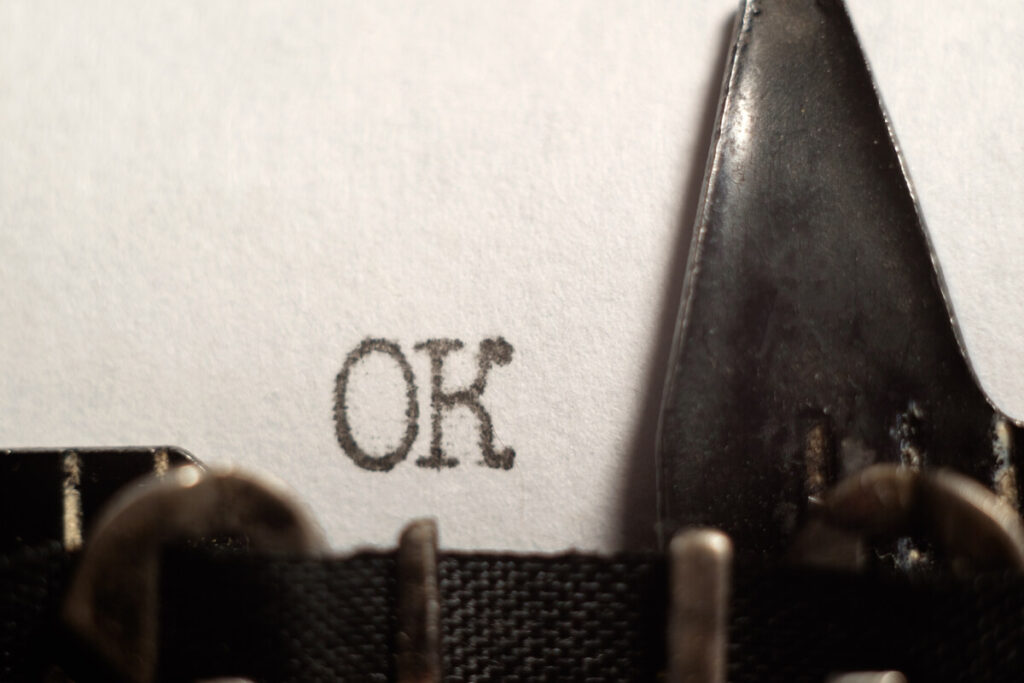
You type “OK” in a text without a second thought, but almost nobody knows it started life as a joke about bad spelling.
A newspaper joke that was never supposed to last
In March 1839, a Boston newspaper called the Boston Morning Post was in on a trend that swept newsrooms at the time: writers deliberately misspelled common phrases for laughs, then shortened the misspelling into an abbreviation.
“OK” was born that way. It stood for “oll korrect,” a comically wrong spelling of “all correct.” It was never meant to be taken seriously, and it definitely wasn’t meant to become one of the most recognized words on the planet.
The joke only worked because readers already knew the correct spelling. That’s the whole gag: everyone gets the reference, and the “wrong” version becomes funnier than the real word.
Why it survived when the other jokes didn’t
The same wave of joke-abbreviations produced plenty of other candidates. “OW” stood for “oll wright,” a fake spelling of “all right.” Nobody uses that today, and most people have never even heard of it.
“OK” got lucky. In 1840, Martin Van Buren ran for reelection as president, and his nickname was “Old Kinderhook,” after his hometown in New York. His supporters formed “OK Clubs,” and the initials matched the joke abbreviation already floating around. A political campaign accidentally gave a spelling gag the biggest marketing push it could ever ask for.
Without that campaign, “OK” was on track to fade out exactly like “OW” did. Instead, it got repeated on posters, in speeches, and in newspapers across the country until it stopped sounding like a joke at all.
No, it doesn’t secretly stand for something serious
A lot of people assume “OK” must be an acronym for something official, maybe a military term, a business phrase, or a serious two-word expression that got shortened over time. It isn’t.
Its entire origin is a spelling gag from a 19th-century newsroom. There’s no hidden meaning waiting to be uncovered, no formal phrase it’s quietly standing in for. The real story is sillier than most of the guesses.
OK vs okay: neither one is wrong
Here’s where “OK” gets genuinely unusual for an English word: it has multiple accepted spellings, and none of them is incorrect.
You can write “OK,” “okay,” or even “ok,” and a dictionary will back you up on all three. Most English words don’t get that kind of flexibility. “Recieve” isn’t a backup spelling of “receive,” it’s just wrong. “OK” is one of the rare exceptions where the language shrugged and let multiple versions coexist.
If you’ve been avoiding “OK” in emails because “okay” felt more official, you can relax. Neither spelling is more correct than the other. Capital “OK” is simply the more universally recognized form, which makes it the safer default when you’re writing something a client or manager will read.
The one thing to actually remember
Next time you type “OK,” you’re typing a 187-year-old spelling joke that got hijacked by a presidential campaign and somehow became one of the most understood words in any language. Use whichever spelling you like, capital “OK” is the safest bet in professional writing, and you never owe anyone an explanation for using either one.