

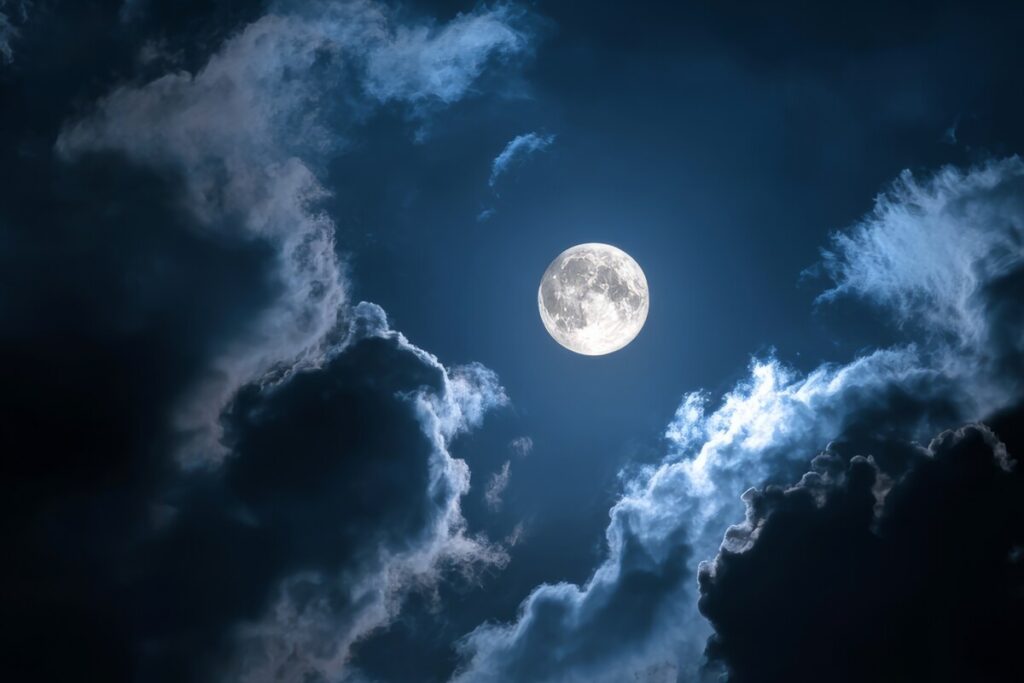
You tell a coworker you only check your work email on weekends “once in a blue moon,” and the phrase you just used is named after a real event that happens in the sky roughly every two to three years.
A blue moon isn’t actually blue
The moon doesn’t change color for this. A “blue moon” is a calendar term for the second full moon to land in the same calendar month, something that only happens occasionally because most months only get one.
The moon’s cycle is close to, but shorter than, a full calendar month. That small gap means the extra full moon eventually lines up inside a single month, and it takes roughly two to three years for the timing to fall into place again.
So when the phrase says “rare,” it means it literally. This isn’t a made-up unit of time like “a month of Sundays,” it’s tied to something you could actually mark on a calendar.
‘Once in a blue moon’ isn’t the same as ‘never’
This is where the phrase trips people up. “Once in a blue moon” means rare but real, not impossible.
Compare it to “when pigs fly,” which describes something that will never happen at all. If you write “I go to the gym once in a blue moon, so don’t count on me for the marathon,” you’re saying it happens sometimes, just not often.
Swap in “when pigs fly” there instead, and you’ve accidentally claimed you never go, which isn’t what most people mean when they reach for this phrase. The two expressions sound like cousins, but they sit at opposite ends of the same idea: one leaves the door open a crack, the other slams it shut.
Same goes for “once in a lifetime,” which implies a single occurrence across an entire life. “Once in a blue moon” is looser than that, it can happen again next year, and the year after that.
The expression is older than the astronomy
Oddly enough, “blue moon” was already a saying centuries before anyone tied it to a calendar event. As far back as the 1500s, calling something a “blue moon” was a way to describe an absurd or impossible claim, similar to saying the moon really was blue.
The precise calendar definition, and the modern “rare but real” meaning attached to it, only really took hold in the 20th century, largely through American almanacs that started tracking these extra full moons by name. Only later did the two ideas, an old joke about an impossible color and a genuine astronomical event, merge into the phrase people use today.
That’s worth knowing next time someone insists an idiom’s origin story is either “obviously literal” or “obviously made up.” This one is both, layered on top of each other over four centuries.
The rule to remember
If something happens occasionally but you can’t count on it, “once in a blue moon” is the right call. If it truly never happens, reach for “when pigs fly” or “never” instead, and save the blue moon for the things that are rare, not the things that are impossible.